
Students’ Perceptions of ChatGPT in Learning

Students’ Perceptions of ChatGPT in Learning

Project Delivery

Time

Spring 2025

Tags

# Data Analysis

# AI In Education

# Student Research

My role

Researcher - Individual project

Tools

R, Quantitative analysis, regression modeling, robust standard errors

Audience

Researchers, educators, higher education stakeholders

Time

Spring 2025

Tags

# Data Analysis

# AI In Education

# Student Research

My role

Researcher - Individual project

Tools

R, Quantitative analysis, regression modeling, robust standard errors

Audience

Researchers, educators, higher education stakeholders

Turning a large public dataset into a testable study of how students perceive ChatGPT’s learning value

Turning a large public dataset into a testable study of how students perceive ChatGPT’s learning value

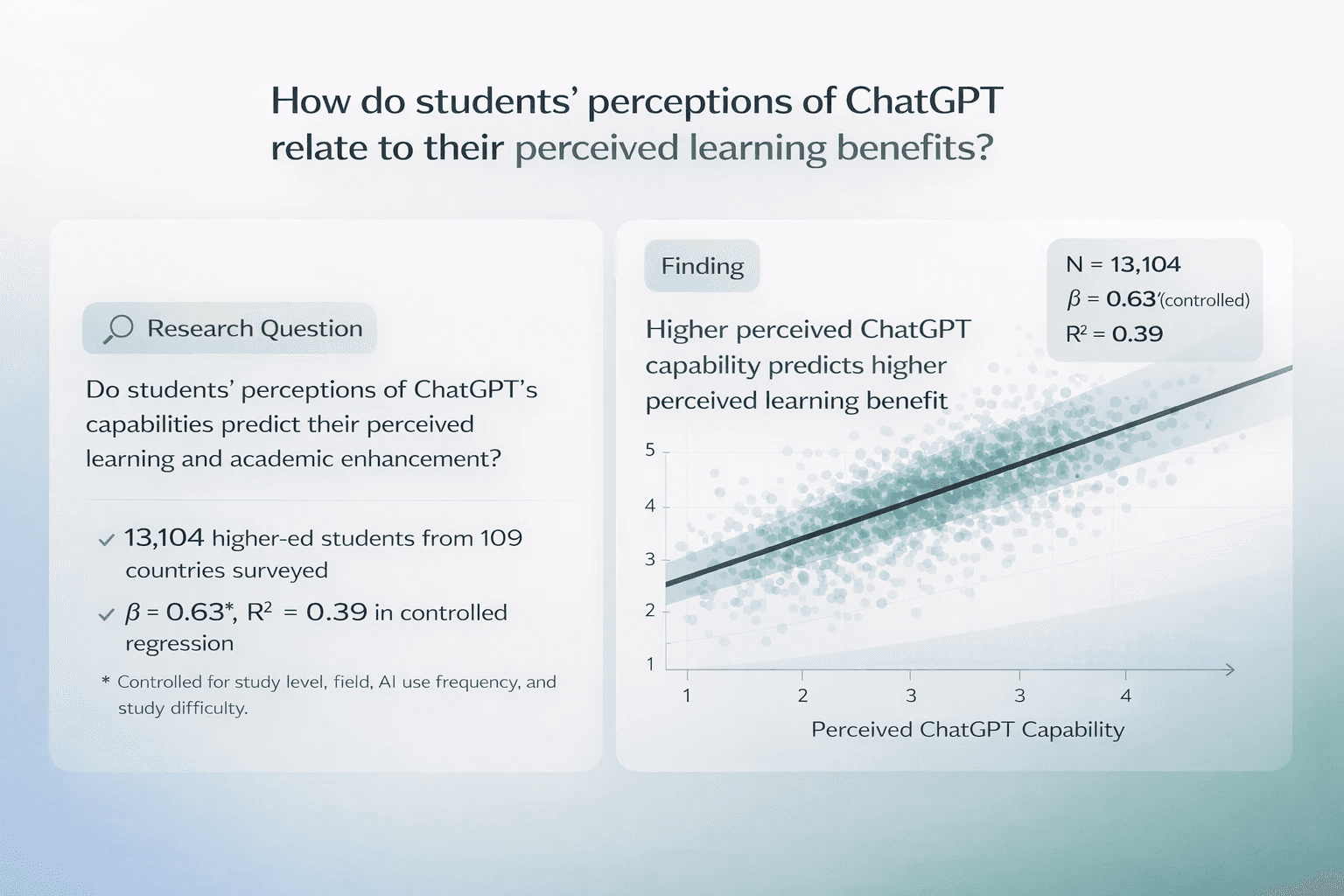
Designed and completed a quantitative research study using a large international higher education dataset to examine whether students who perceived ChatGPT as more capable also reported greater learning and academic enhancement.

Context

AI tools are widely used in higher education, but their educational value remains debated. Beyond adoption rates, this project focused on whether students’ perceptions of ChatGPT’s capabilities were associated with how much they believed it supported their learning.

Problem

Evidence on AI in education often emphasizes usage, while offering less insight into how students’ beliefs about ChatGPT relate to their perceived learning benefit.

Process

  • Framed a research question using a large public higher education dataset

  • Built composite variables to measure perceived capabilities and perceived learning enhancement

  • Applied regression models to test the relationship between the two constructs

  • Added control variables to strengthen interpretation

  • Checked assumptions and used robust standard errors to improve analytic rigor

Deliverables

Research paper

Outcomes

Completed a full quantitative study from research question to model interpretation, while connecting theory, measurement, and statistical analysis. The study also generated practical implications for understanding how students perceive the learning value of ChatGPT in higher education.

Reflection

Research supports project delivery by turning broad questions into evidence that can guide planning. In this case, the analysis helped move conversation about ChatGPT from general interest toward clearer design and implementation considerations.

Context

AI tools are widely used in higher education, but their educational value remains debated. Beyond adoption rates, this project focused on whether students’ perceptions of ChatGPT’s capabilities were associated with how much they believed it supported their learning.

Problem

Evidence on AI in education often emphasizes usage, while offering less insight into how students’ beliefs about ChatGPT relate to their perceived learning benefit.

Process

  • Framed a research question using a large public higher education dataset

  • Built composite variables to measure perceived capabilities and perceived learning enhancement

  • Applied regression models to test the relationship between the two constructs

  • Added control variables to strengthen interpretation

  • Checked assumptions and used robust standard errors to improve analytic rigor

Deliverables

Research paper

Outcomes

Completed a full quantitative study from research question to model interpretation, while connecting theory, measurement, and statistical analysis. The study also generated practical implications for understanding how students perceive the learning value of ChatGPT in higher education.

Reflection

Research supports project delivery by turning broad questions into evidence that can guide planning. In this case, the analysis helped move conversation about ChatGPT from general interest toward clearer design and implementation considerations.

Students’ Perceptions of ChatGPT in Learning

What this project shows

Framing research questions from public data
Connecting theory and analysis
Interpreting findings with caution

EdX Course QA And Maintenance

Faculty Gender and Inclusivity