
Faculty Gender and Inclusivity

Faculty Gender and Inclusivity

Project Delivery

Time

Spring 2025

Tags

# Quant Research

# Inclusivity

# Course Evaluation

My role

Researcher - Individual project

Tools

SPSS

Audience

Researchers, educators, higher education stakeholders

Time

Spring 2025

Tags

# Quant Research

# Inclusivity

# Course Evaluation

My role

Researcher - Individual project

Tools

SPSS

Audience

Researchers, educators, higher education stakeholders

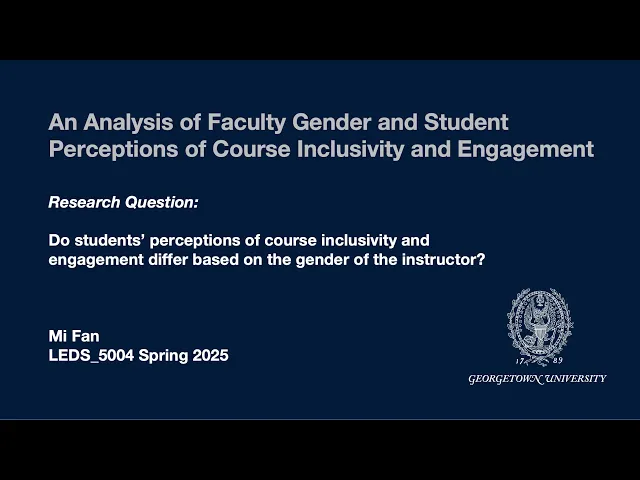
Using course evaluation data to examine whether students perceived differences in inclusivity and engagement by faculty gender

Using course evaluation data to examine whether students perceived differences in inclusivity and engagement by faculty gender

Investigated whether students’ perceptions of course inclusivity and engagement varied by faculty gender using Georgetown’s course evaluation survey data. The project focused on coding variables, building a composite measure, comparing group means, and interpreting the broader implications of gender dynamics in higher education.

Context

Prior research has shown that instructor gender can shape how students interpret teaching, engagement, and inclusivity. This study examined whether similar patterns appeared in Georgetown course evaluation data.

Problem

Student evaluations are often influenced by factors beyond teaching effectiveness, making it important to examine whether perceptions of inclusivity and engagement differ by faculty gender.

Process

  • Reviewed prior research on gender and student evaluations

  • Built a composite variable from six survey items and recoded faculty gender for group comparison

  • Ran an independent samples t-test in SPSS

  • Interpreted mean differences in context

Deliverables

  • Research report

  • Final presentation of findings

Outcomes

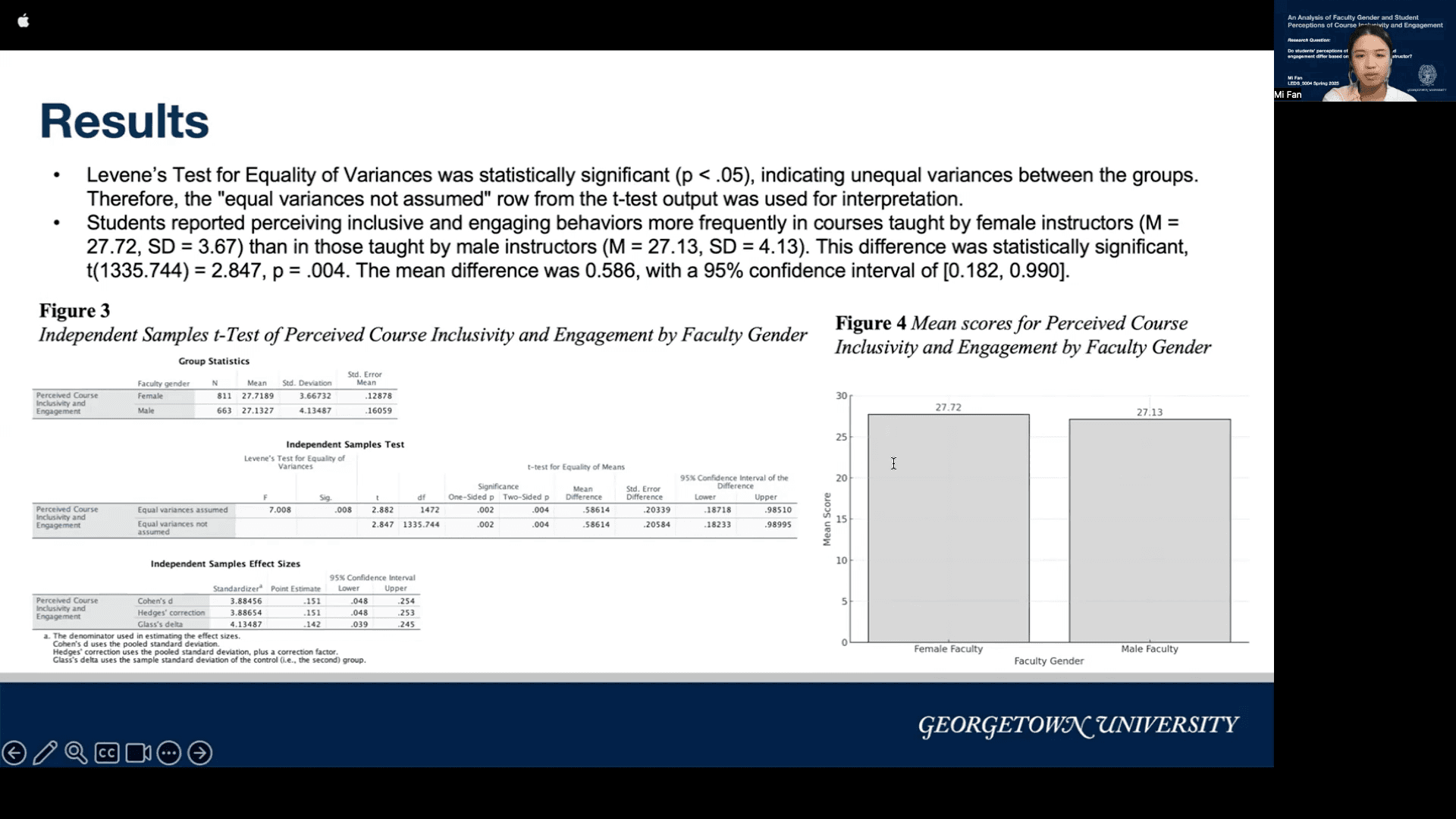
Completed a full statistical analysis using Georgetown course evaluation data and found a small but statistically significant difference in perceived inclusivity and engagement by faculty gender, with female faculty rated slightly higher on the composite measure. The project also strengthened my ability to explain statistical findings through presentation and discussion.

Reflection

Research can support decision-making by turning institutional data into clearer, more grounded conversations about learner experience and educational practice.

Context

Prior research has shown that instructor gender can shape how students interpret teaching, engagement, and inclusivity. This study examined whether similar patterns appeared in Georgetown course evaluation data.

Problem

Student evaluations are often influenced by factors beyond teaching effectiveness, making it important to examine whether perceptions of inclusivity and engagement differ by faculty gender.

Process

  • Reviewed prior research on gender and student evaluations

  • Built a composite variable from six survey items and recoded faculty gender for group comparison

  • Ran an independent samples t-test in SPSS

  • Interpreted mean differences in context

Deliverables

  • Research report

  • Final presentation of findings

Outcomes

Completed a full statistical analysis using Georgetown course evaluation data and found a small but statistically significant difference in perceived inclusivity and engagement by faculty gender, with female faculty rated slightly higher on the composite measure. The project also strengthened my ability to explain statistical findings through presentation and discussion.

Reflection

Research can support decision-making by turning institutional data into clearer, more grounded conversations about learner experience and educational practice.

Faculty Gender and Inclusivity

What this project shows

Using institutional data to study educational questions
Building measurable variables from survey items
Interpreting statistical differences in context

Students’ Perceptions of ChatGPT in Learning

AI Roles For Collective Learning