
The Skyweave Loom: A Tabletop Game for AI Literacy
The Skyweave Loom: A Tabletop Game for AI Literacy
Learning Design
Time
2026 Spring
Tags
# AI Literacy
# Game-Based Learning
# Systems Design
My role
Game Designer - Individual Project
Tools
Canva
Time
2026 Spring
Tags
# AI Literacy
# Game-Based Learning
# Systems Design
My role
Game Designer - Individual Project
Tools
Canva
A tabletop game that turns AI literacy and risk into an interactive learning experience.
A tabletop game that turns AI literacy and risk into an interactive learning experience.
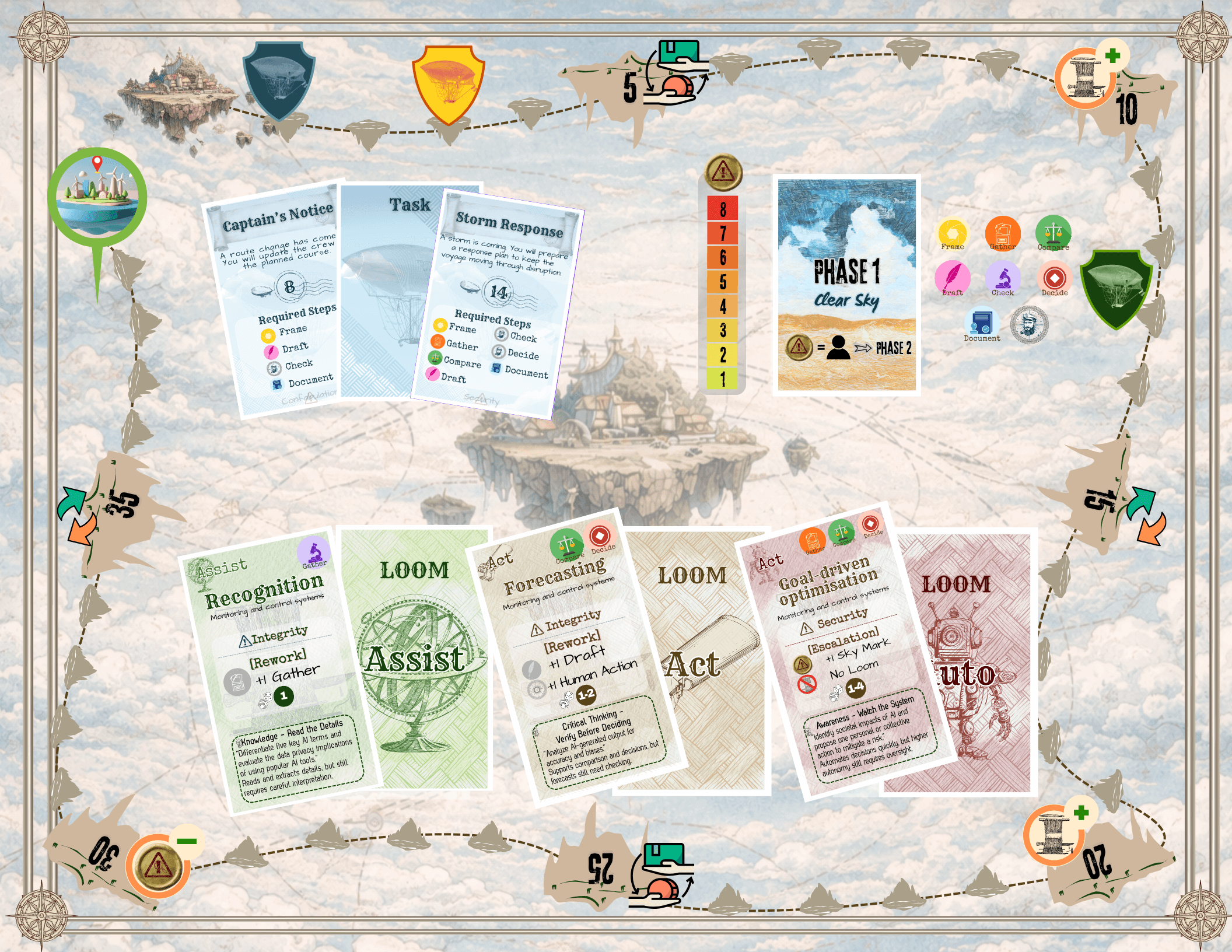
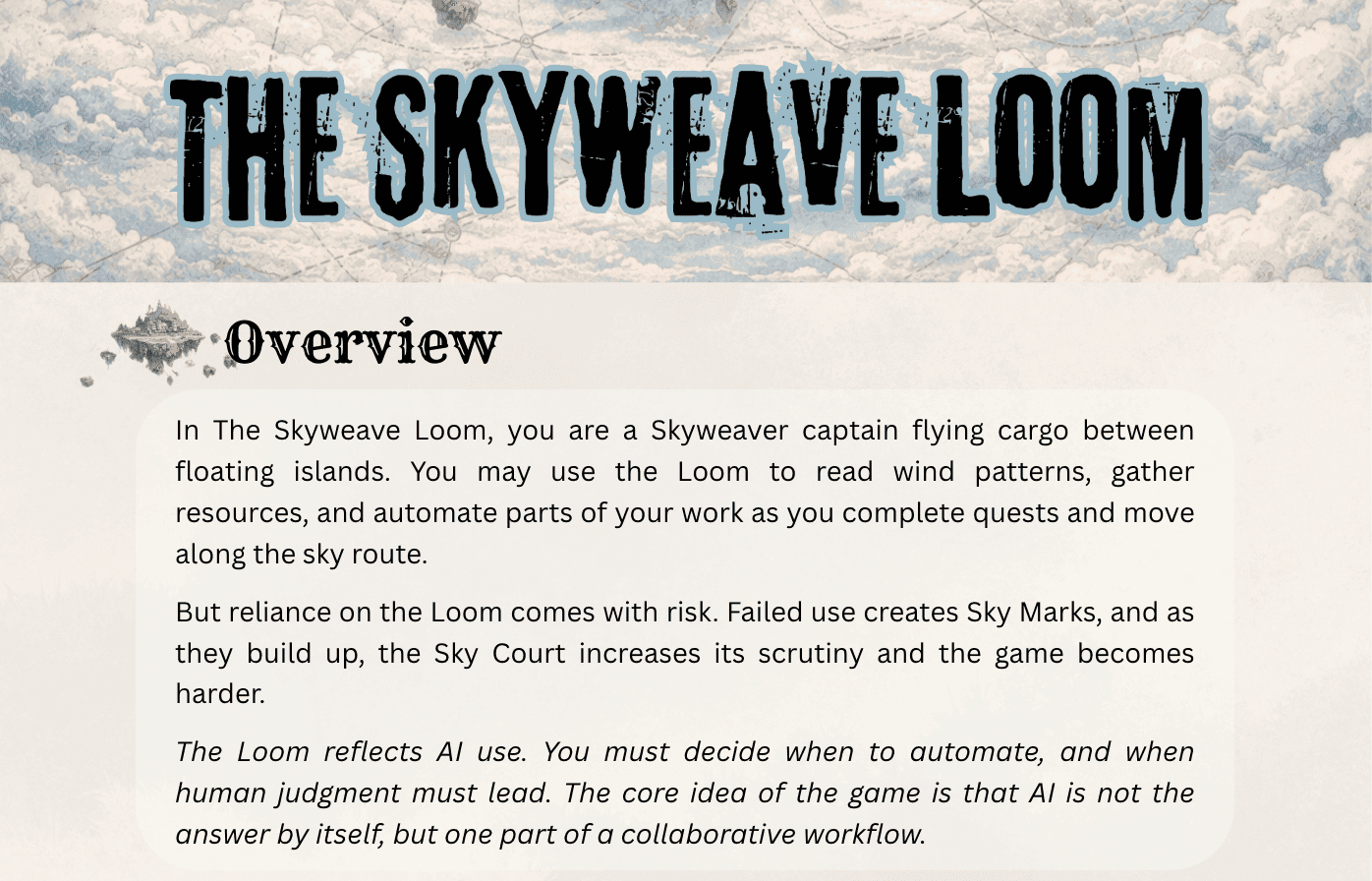
The Skyweave Loom is a tabletop game prototype designed to help players explore how AI can support work, where risks emerge, and what responsibilities should remain with humans. The project translates frameworks on AI use and risk into a playable system of tasks, decisions, constraints, and consequences.
Context
As AI becomes more common in academic and professional workflows, many conversations about AI literacy stay at the level of explanation or policy. I wanted to explore a more interactive format that could make these ideas easier to experience, discuss, and question. This project uses game-based learning to turn concepts like human oversight, workflow design, and AI risk into something players can actively engage with.
Problem
How might abstract AI literacy and risk frameworks become engaging and discussable through play?
Process
Defining the core learning system
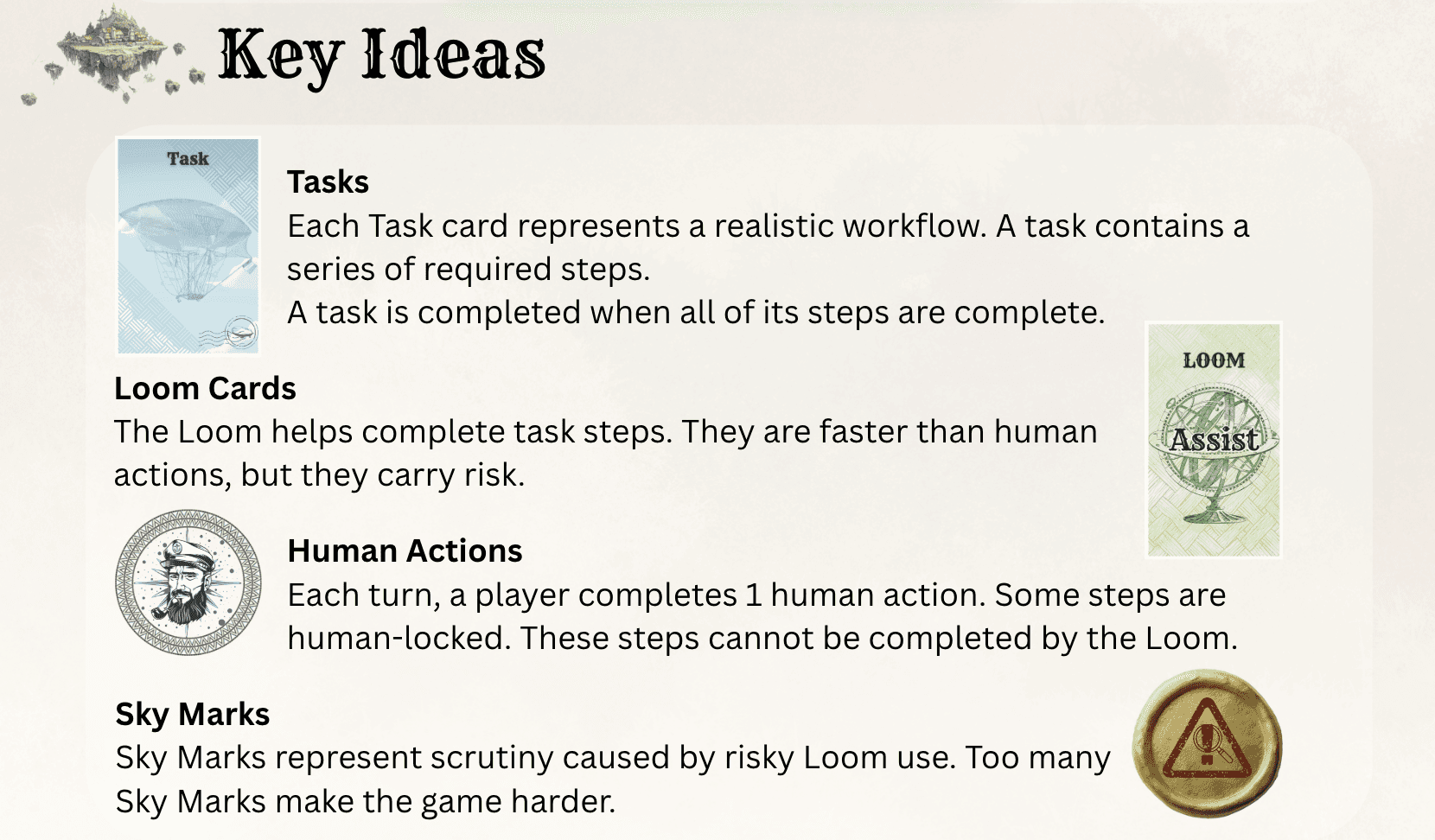
Identified the key ideas the game needed to teach: tasks, Loom cards, human actions, and Sky Marks. Rather than presenting AI literacy as static information, I designed these as interacting elements in the game system. Tasks represent realistic workflows, Loom cards help complete steps faster but introduce risk, human actions preserve judgment, and Sky Marks make scrutiny visible over time.
Translating frameworks into task structure and risk
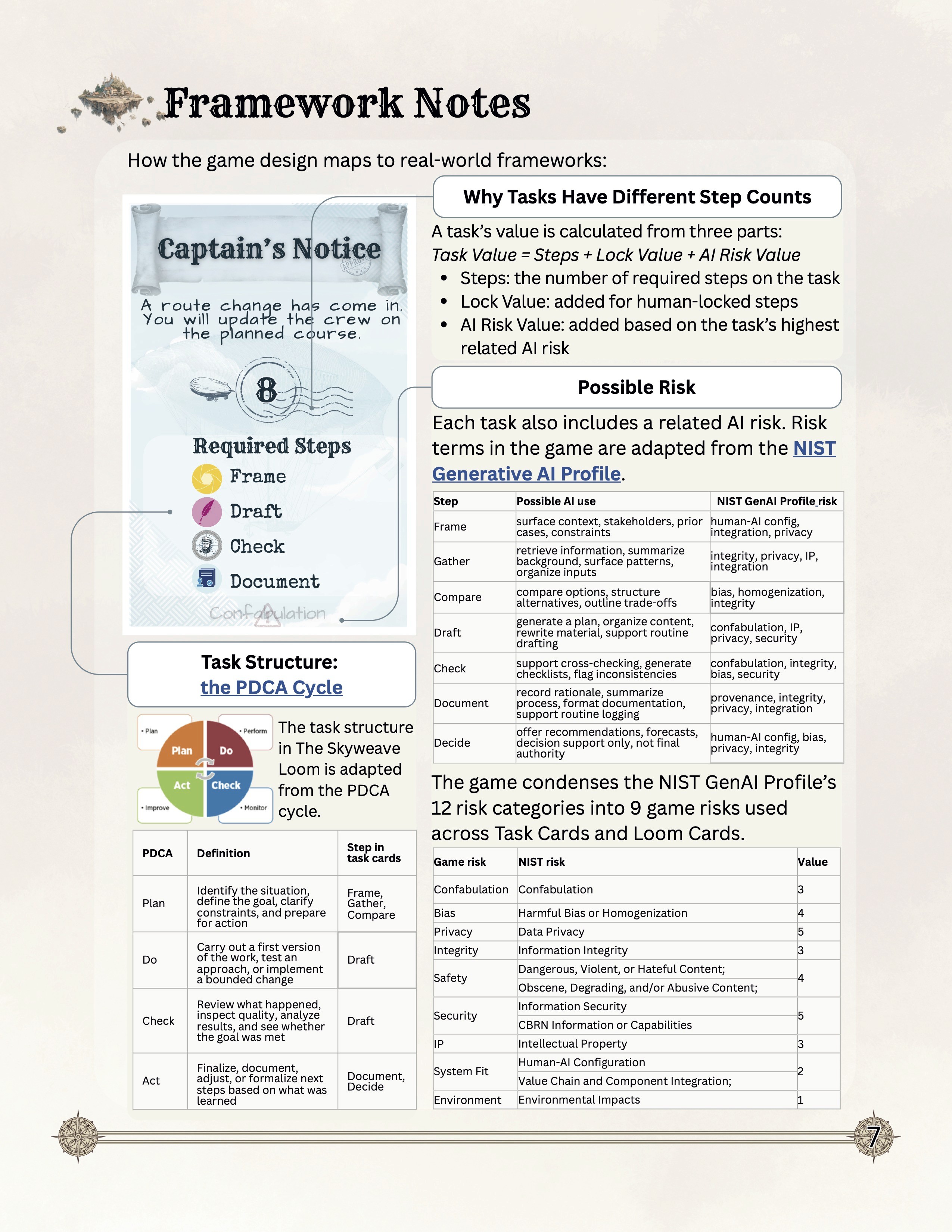
Mapped the game system to real-world frameworks so the mechanics would reflect more than theme alone. The task structure draws on the PDCA cycle, while the game’s risk categories adapt ideas from the NIST Generative AI Profile into a smaller and more playable set of risks. This step helped shape task value, workflow logic, and the relationship between AI use and consequence.
Building the Loom card system
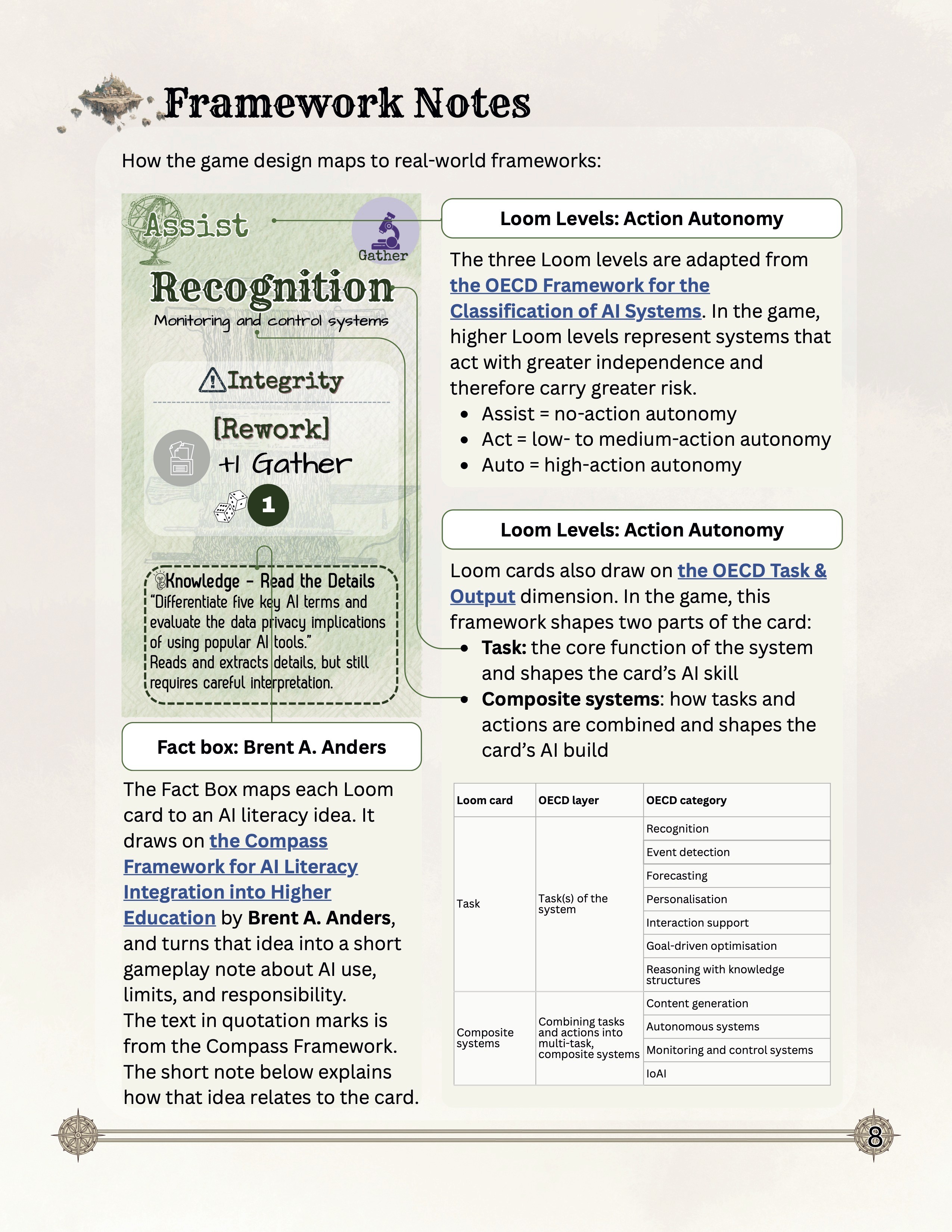
Developed the Loom cards by connecting them to the OECD framework for AI systems and the Compass Framework for AI literacy. The different Loom levels represent different degrees of action autonomy, and each card includes a short fact box that links gameplay to an AI literacy idea.
Turning ideas into rule logic
Designed the rule structure to make AI use feel strategic rather than automatic. Players can use Loom cards to complete work more quickly, but each use may trigger risk through dice rolls and effects. Some workflow steps are human-locked, which keeps final judgment and certain responsibilities with the player instead of the system. I also introduced Sky Marks and phase changes so that risky behavior affects not only a single turn but the overall difficulty of the game.
Balancing playability and learning
As the system developed, I adjusted rules to keep the game understandable while still reflecting real tradeoffs. This included thinking through turn order, task completion, AI access, scrutiny thresholds, and win conditions.
Deliverables
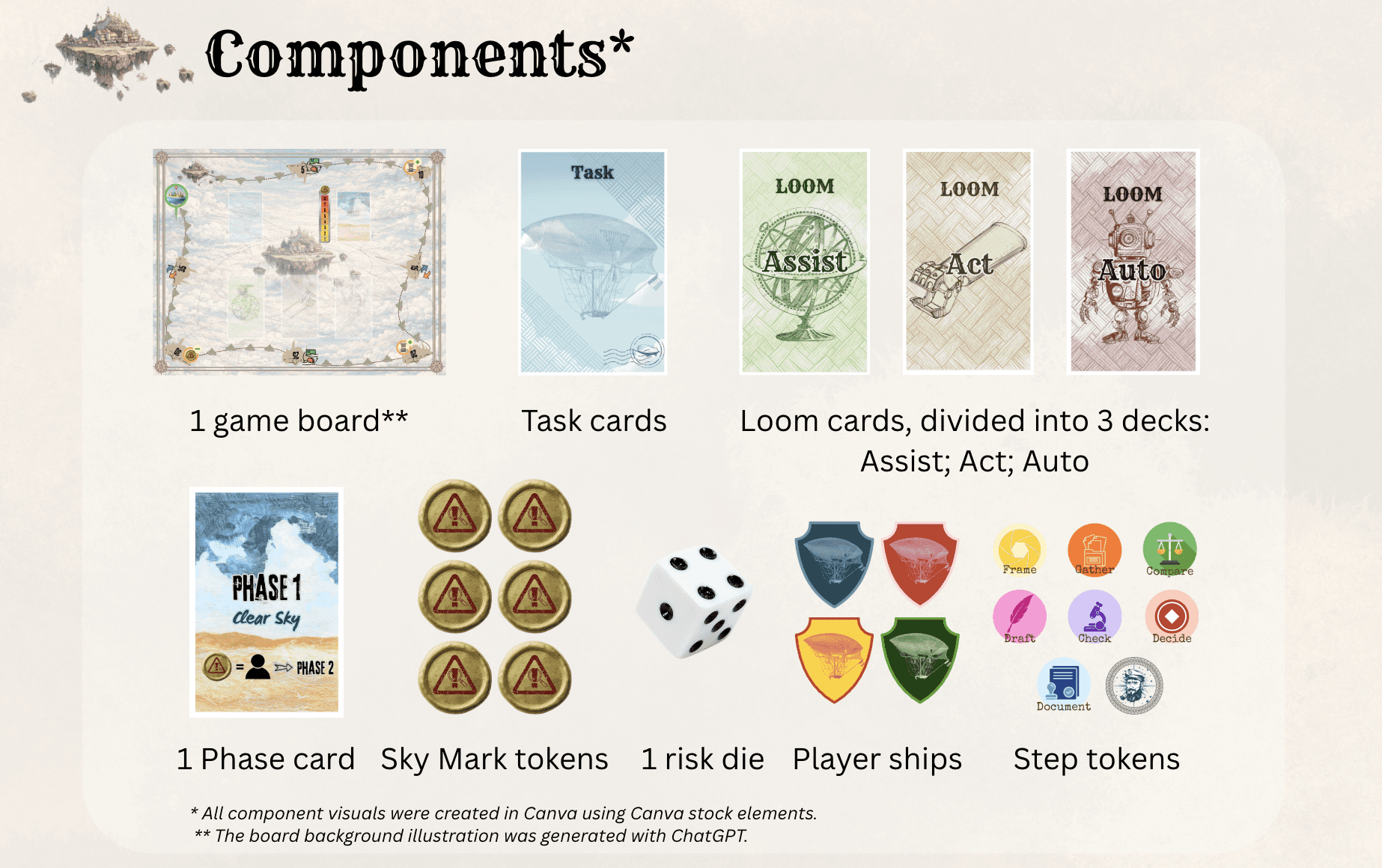
A playable board game prototype including a game board, task cards, AI cards, rule structure, risk system, and supporting visual assets.
Outcomes
The project produced a playable board game prototype, complete with a task system, Loom card system, risk mechanics, and supporting visual assets. It turned abstract ideas about AI literacy, risk, and human responsibility into a concrete experience that players can interact with, question, and discuss. The project demonstrates my ability to translate complex frameworks into a structured learning system that is both engaging and instructionally meaningful.
Context
As AI becomes more common in academic and professional workflows, many conversations about AI literacy stay at the level of explanation or policy. I wanted to explore a more interactive format that could make these ideas easier to experience, discuss, and question. This project uses game-based learning to turn concepts like human oversight, workflow design, and AI risk into something players can actively engage with.
Problem
How might abstract AI literacy and risk frameworks become engaging and discussable through play?
Process
Defining the core learning system
Identified the key ideas the game needed to teach: tasks, Loom cards, human actions, and Sky Marks. Rather than presenting AI literacy as static information, I designed these as interacting elements in the game system. Tasks represent realistic workflows, Loom cards help complete steps faster but introduce risk, human actions preserve judgment, and Sky Marks make scrutiny visible over time.
Translating frameworks into task structure and risk
Mapped the game system to real-world frameworks so the mechanics would reflect more than theme alone. The task structure draws on the PDCA cycle, while the game’s risk categories adapt ideas from the NIST Generative AI Profile into a smaller and more playable set of risks. This step helped shape task value, workflow logic, and the relationship between AI use and consequence.
Building the Loom card system
Developed the Loom cards by connecting them to the OECD framework for AI systems and the Compass Framework for AI literacy. The different Loom levels represent different degrees of action autonomy, and each card includes a short fact box that links gameplay to an AI literacy idea.
Turning ideas into rule logic
Designed the rule structure to make AI use feel strategic rather than automatic. Players can use Loom cards to complete work more quickly, but each use may trigger risk through dice rolls and effects. Some workflow steps are human-locked, which keeps final judgment and certain responsibilities with the player instead of the system. I also introduced Sky Marks and phase changes so that risky behavior affects not only a single turn but the overall difficulty of the game.
Balancing playability and learning
As the system developed, I adjusted rules to keep the game understandable while still reflecting real tradeoffs. This included thinking through turn order, task completion, AI access, scrutiny thresholds, and win conditions.
Deliverables
A playable board game prototype including a game board, task cards, AI cards, rule structure, risk system, and supporting visual assets.
Outcomes
The project produced a playable board game prototype, complete with a task system, Loom card system, risk mechanics, and supporting visual assets. It turned abstract ideas about AI literacy, risk, and human responsibility into a concrete experience that players can interact with, question, and discuss. The project demonstrates my ability to translate complex frameworks into a structured learning system that is both engaging and instructionally meaningful.
The Skyweave Loom: A Tabletop Game for AI Literacy
What this project shows
Turned AI literacy and risk frameworks into a playable learning experience
Designed game rules that make tradeoffs, scrutiny, and human responsibility visible
Combined systems thinking, visual design, and learning design in one prototype
Summer Online Course Support
Beginning Chinese For Kids