
Modular, Skills-Based Learning

Modular, Skills-Based Learning

Future Directions

Time

Spring 2025

Tags

# Higher Education

# Curriculum

# Systems Thinking

My role

Researcher and concept designer - Individual project

Audience

Higher education leaders, faculty, learning designers

Time

Spring 2025

Tags

# Higher Education

# Curriculum

# Systems Thinking

My role

Researcher and concept designer - Individual project

Audience

Higher education leaders, faculty, learning designers

From single-discipline degrees to modular, skills-based learning

From single-discipline degrees to modular, skills-based learning

Examined how traditional single-discipline degree models fall short in a skills-based economy and proposed a modular, interdisciplinary alternative. Using the lens of wicked problems, the project identified leverage points for systemic change in higher education and outlined a more flexible model for curriculum design, student agency, and hybrid skill development.

Context

Higher education remains largely organized around discipline-bound degree pathways, even as workforce demands increasingly value interdisciplinary and hybrid skills.

Process

  • Framed the issue through the lens of wicked problems

  • Synthesized research on workforce change and interdisciplinary learning

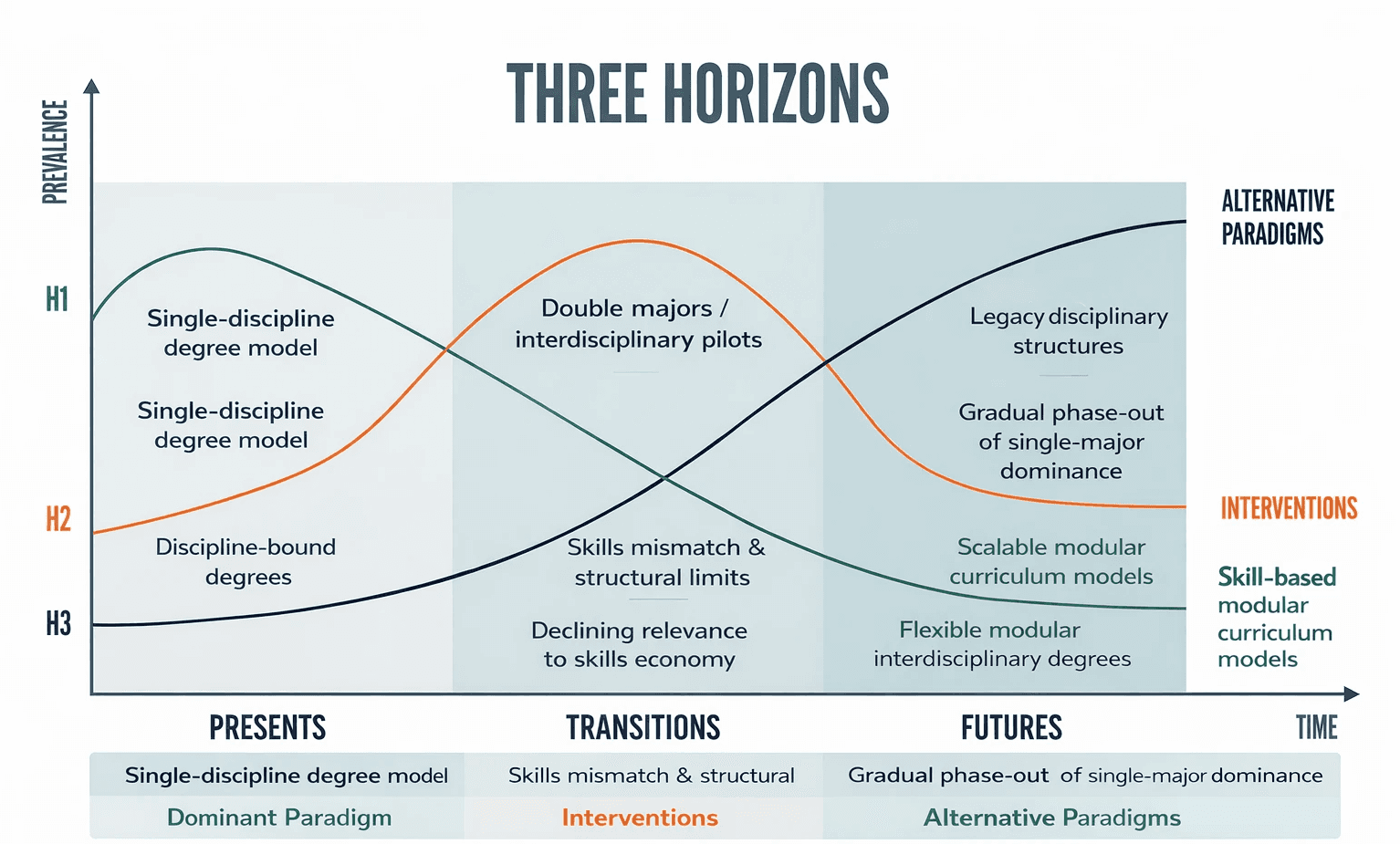
  • Mapped a modular alternative across core, disciplinary, interdisciplinary, and applied learning

  • Identified barriers in governance, funding, and faculty reward systems

  • Proposed leverage points for systemic change

Problem

Single-discipline degree structures are rigid and slow to adapt, making it harder for students to build cross-disciplinary knowledge and flexible skill combinations.

Deliverables

Research paper with problem framing, a modular learning model, and systems-level recommendations for higher education

Outcomes

Produced a future-facing proposal that connected workforce change, interdisciplinary learning, and institutional design, while identifying specific structures that would need to change.


Reflection

This project pushed me to think at the level of educational systems rather than individual courses. It reinforced that meaningful innovation in higher education depends not only on new curricular ideas, but on changing the structures and values that keep older models in place.

Context

Higher education remains largely organized around discipline-bound degree pathways, even as workforce demands increasingly value interdisciplinary and hybrid skills.

Process

  • Framed the issue through the lens of wicked problems

  • Synthesized research on workforce change and interdisciplinary learning

  • Mapped a modular alternative across core, disciplinary, interdisciplinary, and applied learning

  • Identified barriers in governance, funding, and faculty reward systems

  • Proposed leverage points for systemic change

Problem

Single-discipline degree structures are rigid and slow to adapt, making it harder for students to build cross-disciplinary knowledge and flexible skill combinations.

Deliverables

Research paper with problem framing, a modular learning model, and systems-level recommendations for higher education

Outcomes

Produced a future-facing proposal that connected workforce change, interdisciplinary learning, and institutional design, while identifying specific structures that would need to change.


Reflection

This project pushed me to think at the level of educational systems rather than individual courses. It reinforced that meaningful innovation in higher education depends not only on new curricular ideas, but on changing the structures and values that keep older models in place.

Modular, Skills-Based Learning

What this project shows

  • Applying systems thinking through wicked problems

  • Using the Three Horizons Framework to frame change

  • Proposing modular, future-facing learning structures

AI Roles For Collective Learning

Chinese Cooking-And-Language Kit