Beginning Chinese For Kids

Beginning Chinese For Kids

Learning Design

Time

Spring 2025

Tags

# Language Learning

# Interactive Learning

# Curriculum Design

My role

Learning designer - Individual Project

Tools

Canvas, H5P, storyboard planning, video editing, curriculum mapping

Audience

Overseas heritage learners ages 6-9

Time

Spring 2025

Tags

# Language Learning

# Interactive Learning

# Curriculum Design

My role

Learning designer - Individual Project

Tools

Canvas, H5P, storyboard planning, video editing, curriculum mapping

Audience

Overseas heritage learners ages 6-9

Designing an interactive Chinese e-learning course for young heritage learners

Designing an interactive Chinese e-learning course for young heritage learners

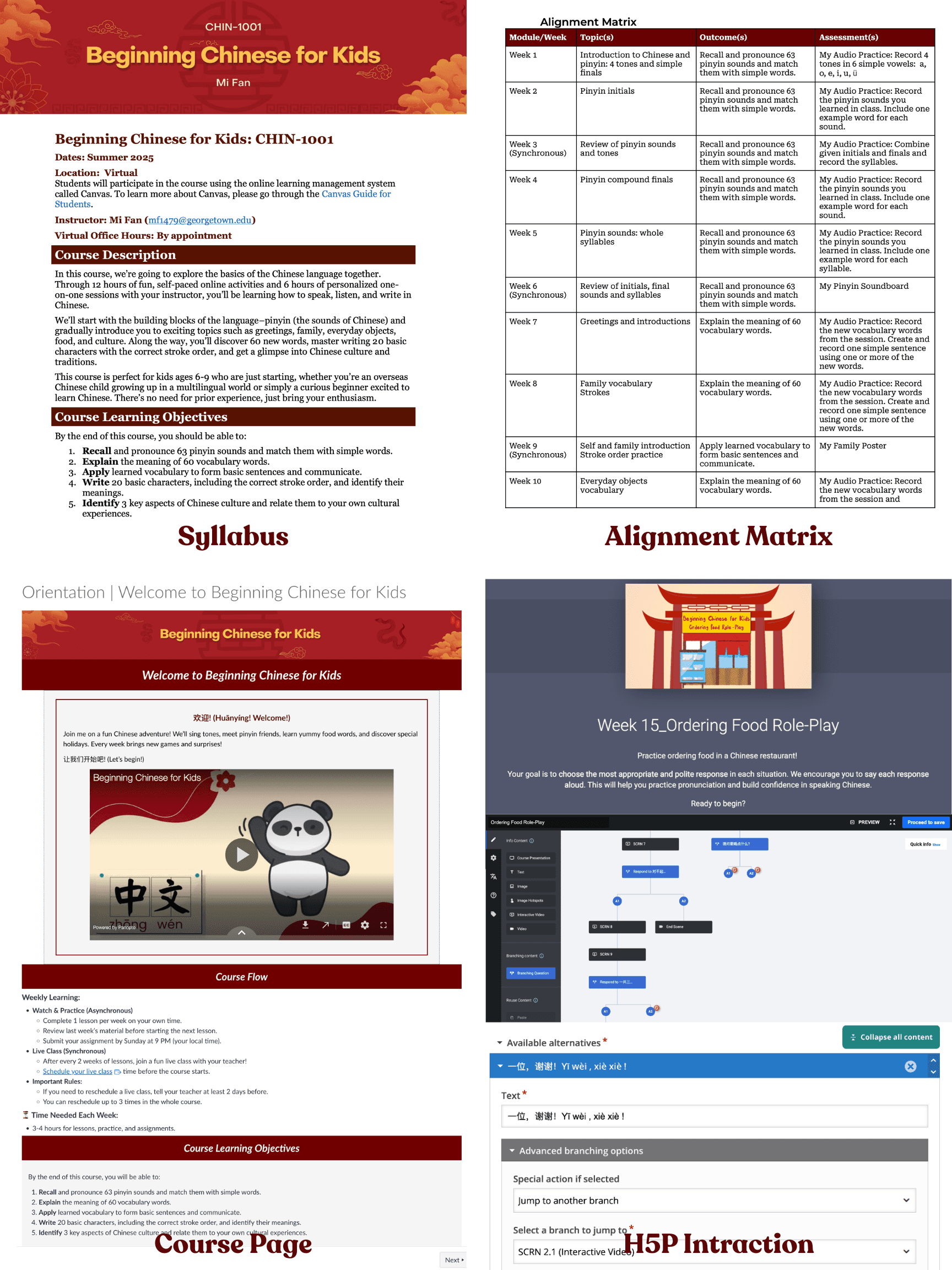
Designed a Chinese e-learning course for young heritage learners, including course proposal, syllabus, curriculum design, and a sample module. The project focused on creating a learner-centered, media-rich online experience that combined structured pacing, contextualized language tasks, and interactive practice.

Context

The course was designed for children ages 6-9 learning Chinese online in a bisynchronous format, with asynchronous learning supported by regular check-ins for progress and questions.

Problem

Asynchronous language learning for young beginners needs stronger engagement and pacing, along with more visual, contextualized practice that supports real language use.

Process

  • Started with a course proposal and defined course-level learning outcomes

  • Designed the syllabus and overall course flow before building module content

  • Used alignment planning to connect outcomes, activities, and assessments

  • Developed a sample module on food and drink as a learner-facing prototype

  • Built an H5P branching scenario for ordering food in a realistic context

  • Used storyboards to plan interaction logic before developing media and activities

Deliverables

  • Syllabus

  • Course design document with alignment matrix

  • Orientation and Week 15 sample module

  • H5P branching scenario for ordering food

Outcomes

Produced a full course prototype that demonstrated how curriculum planning could be translated into an engaging online learning experience for young heritage learners. Instructor feedback was strongly positive, including: “I am thrilled with what you were able to create in just a few short months.”

Reflection

This project reinforced that strong e-learning for young learners depends on more than content delivery. It requires intentional pacing, contextual task design, and interactions that make language use feel meaningful. It also strengthened my ability to move from course-level planning to detailed module and interaction design.

Context

The course was designed for children ages 6-9 learning Chinese online in a bisynchronous format, with asynchronous learning supported by regular check-ins for progress and questions.

Problem

Asynchronous language learning for young beginners needs stronger engagement and pacing, along with more visual, contextualized practice that supports real language use.

Process

  • Started with a course proposal and defined course-level learning outcomes

  • Designed the syllabus and overall course flow before building module content

  • Used alignment planning to connect outcomes, activities, and assessments

  • Developed a sample module on food and drink as a learner-facing prototype

  • Built an H5P branching scenario for ordering food in a realistic context

  • Used storyboards to plan interaction logic before developing media and activities

Deliverables

  • Syllabus

  • Course design document with alignment matrix

  • Orientation and Week 15 sample module

  • H5P branching scenario for ordering food

Outcomes

Produced a full course prototype that demonstrated how curriculum planning could be translated into an engaging online learning experience for young heritage learners. Instructor feedback was strongly positive, including: “I am thrilled with what you were able to create in just a few short months.”

Reflection

This project reinforced that strong e-learning for young learners depends on more than content delivery. It requires intentional pacing, contextual task design, and interactions that make language use feel meaningful. It also strengthened my ability to move from course-level planning to detailed module and interaction design.

Beginning Chinese For Kids

What this project shows

Designing interactive language learning
Structuring curriculum into engaging modules
Creating media-rich asynchronous learning

Summer Online Course Support

Mind Mapping In Elementary English