
AI Roles For Collective Learning
AI Roles For Collective Learning
Future Directions
Time
Spring 2025
Tags
# AI Pedagogy
# Learning Design
# Concept Development
My role
Researcher and concept designer - Individual project
Audience
Educators, learning designers
Time
Spring 2025
Tags
# AI Pedagogy
# Learning Design
# Concept Development
My role
Researcher and concept designer - Individual project
Audience
Educators, learning designers
Reinterpreting AI roles: From individuals to communities.
Reinterpreting AI roles: From individuals to communities.
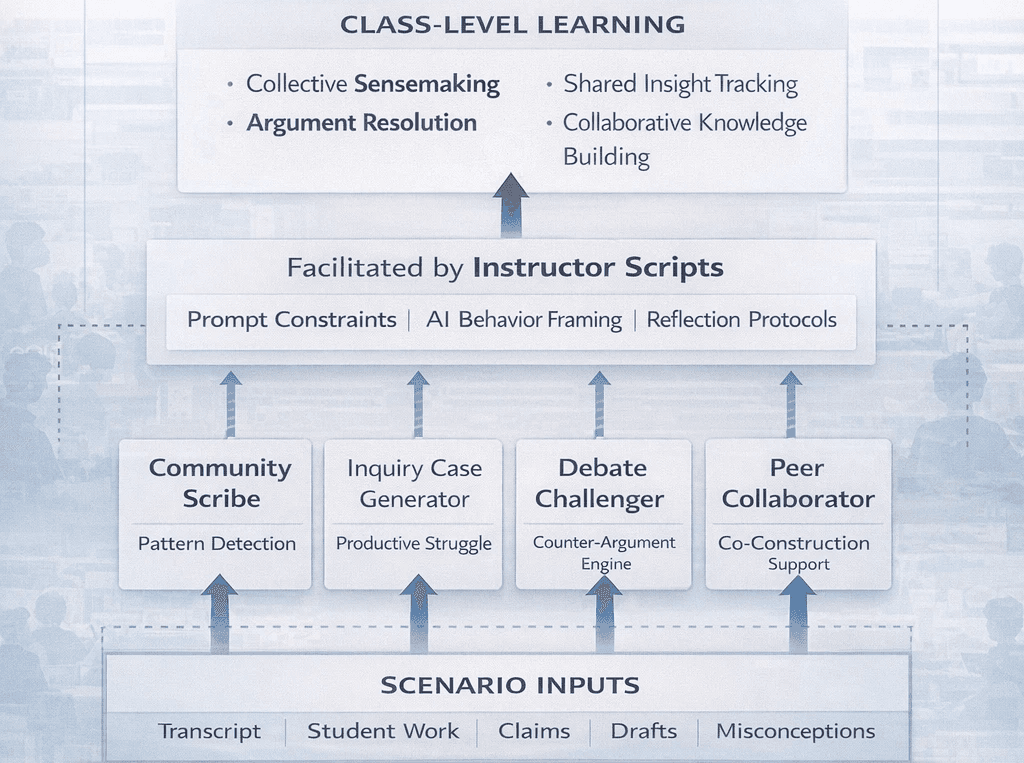
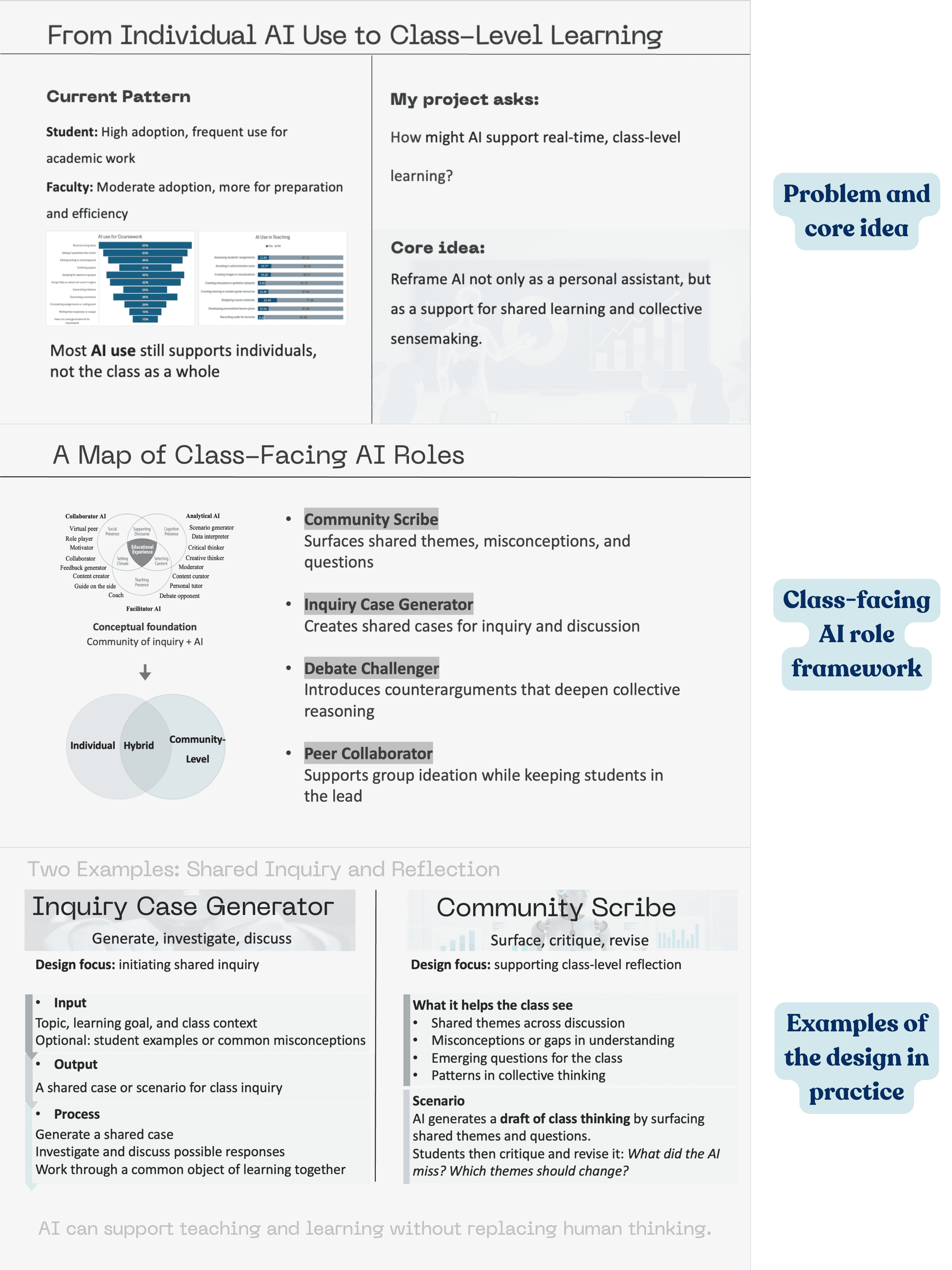
Designed a conceptual framework for class-level AI use in higher education. Instead of focusing on AI as an individual study tool, this project reinterpreted AI as a support for collective learning and proposed four class-facing roles: Community Scribe, Inquiry Case Generator, Debate Challenger, and Peer Collaborator. The framework draws on Community of Inquiry and recent research on AI, engagement, and collaborative learning.
Context
The project began from a gap in current AI use. Students use AI heavily for individual academic work, faculty use it more selectively for preparation, and classroom integration remains limited. The presentation frames this as an opportunity to design AI for real-time, class-level learning rather than only individual support.
Problem
Most AI use in education still centers on personalization for individual learners. This leaves less attention to collaboration, community-building, peer learning, and class-level progress, even though those are central to many learning experiences.
Process
Synthesized research on student AI use, faculty adoption, engagement, and collaborative learning to identify a class-level design gap.
Used Community of Inquiry as a framing model to reinterpret AI roles beyond individual support.
Built a conceptual map linking AI roles, learning mechanisms, and possible outcomes.
Developed four class-facing roles: Community Scribe, Inquiry Case Generator, Debate Challenger, and Peer Collaborator.
Created scenario-based applications to show how each role could operate in real classroom activities.
Deliverables
Conceptual framework for collective learning with AI
Role map connecting individual, hybrid, and community-level AI roles
Four class-facing AI roles
Scenario-based classroom applications

Outcomes
Produced a future-facing framework that reframed AI from an individual support tool to a class-level learning design question. The project translated theory into a set of usable roles and classroom scenarios, with Inquiry Case Generator standing out as a model for using AI to introduce productive struggle and shared inquiry.

This project was presented at Grand Rounds, A Showcase for Student Research and Projects from Across the Georgetown Tech & Society Curriculum, as part of Georgetown Tech & Society Week.
Reflection
Classroom AI can benefit both course learning and AI literacy. Future-facing design is not only about adding new tools, but about deciding how those tools should support learning goals, participation, and shared classroom experience.
Context
The project began from a gap in current AI use. Students use AI heavily for individual academic work, faculty use it more selectively for preparation, and classroom integration remains limited. The presentation frames this as an opportunity to design AI for real-time, class-level learning rather than only individual support.
Problem
Most AI use in education still centers on personalization for individual learners. This leaves less attention to collaboration, community-building, peer learning, and class-level progress, even though those are central to many learning experiences.
Process
Synthesized research on student AI use, faculty adoption, engagement, and collaborative learning to identify a class-level design gap.
Used Community of Inquiry as a framing model to reinterpret AI roles beyond individual support.
Built a conceptual map linking AI roles, learning mechanisms, and possible outcomes.
Developed four class-facing roles: Community Scribe, Inquiry Case Generator, Debate Challenger, and Peer Collaborator.
Created scenario-based applications to show how each role could operate in real classroom activities.
Deliverables
Conceptual framework for collective learning with AI
Role map connecting individual, hybrid, and community-level AI roles
Four class-facing AI roles
Scenario-based classroom applications
Outcomes
Produced a future-facing framework that reframed AI from an individual support tool to a class-level learning design question. The project translated theory into a set of usable roles and classroom scenarios, with Inquiry Case Generator standing out as a model for using AI to introduce productive struggle and shared inquiry.
This project was presented at Grand Rounds, A Showcase for Student Research and Projects from Across the Georgetown Tech & Society Curriculum, as part of Georgetown Tech & Society Week.
Reflection
Classroom AI can benefit both course learning and AI literacy. Future-facing design is not only about adding new tools, but about deciding how those tools should support learning goals, participation, and shared classroom experience.
AI Roles For Collective Learning
What this project shows
Designing AI for collective learning
Translating theory into classroom approaches
Proposing future-facing learning roles
Faculty Gender and Inclusivity
Chinese Cooking-And-Language Kit